Casey Kasem At40 The 70s Free Download UPDATED
Casey Kasem At40 The 70s Free Download
| Adult contemporary | |
|---|---|
 Celine Dion is often referred to as the "Queen of Adult Gimmicky".[ane] With global sales of over 200 million records, she is i of the all-time-selling music artists of all fourth dimension. | |
| Stylistic origins |
|
| Cultural origins | 1960s, United States |
| Subgenres | |
| |
In N American music, developed gimmicky music (AC) is a course of radio-played popular music, ranging from 1960s song and 1970s soft rock music[two] to predominantly ballad-heavy music of the present twenty-four hours, with varying degrees of easy listening, pop, soul, R&B, placidity tempest and stone influence.[iii] [4] [5] Adult contemporary is generally a continuation of the easy listening and soft stone style that became popular in the 1960s and 1970s with some adjustments that reflect the development of pop/rock music.[half-dozen]
Adult gimmicky tends to take lush, soothing and highly polished qualities where accent on melody and harmonies is accentuated. It is normally melodic plenty to go a listener's attending, and is inoffensive and pleasurable enough to work well every bit background music. Like most of pop music, its songs tend to be written in a basic format employing a poetry–chorus construction.[7] The format is heavy on romantic sentimental ballads which mostly use acoustic instruments (though bass guitar is commonly used) such as audio-visual guitars, pianos, saxophones, and sometimes an orchestral prepare. The electrical guitars are normally faint and high-pitched. Even so, recent developed contemporary music may feature synthesizers (and other electronics, such as drum machines).[8]
An Ac radio station may play mainstream music, but it usually excludes hip-hop and some forms of dance-pop and teen pop, as these are less popular among adults, the target demographic. AC radio frequently targets the 25–44 age grouping,[9] the demographic that has received the nearly attending from advertisers since the 1960s. A common practise in recent years of adult contemporary stations is to play less newer music and more hits of the by. This de-emphasis on new songs slows the progression of the AC chart.[10]
Over the years, Air conditioning has spawned subgenres including "hot AC", "soft Ac" (as well known as "lite Ac"), "urban Air-conditioning", "rhythmic AC", and "Christian AC" (a softer type of contemporary Christian music). Some stations play only "hot AC", "soft AC", or just 1 of the variety of subgenres. Therefore, it is non usually considered a specific genre of music; information technology is merely an assemblage of selected songs from artists of many different genres.
History [edit]
1960s: Early on roots; easy listening and soft rock [edit]

Johnny Mathis full-bodied on romantic readings of jazz and popular standards for the adult contemporary audience of the 1960s and 1970s.[xi]
Developed contemporary traces its roots to the 1960s easy listening format, which adopted a seventy—fourscore% instrumental to 20–30% vocal mix. A few offered xc% instrumentals, and a handful were entirely instrumental. The easy listening format, equally information technology was first known, was built-in of a want past some radio stations in the late 1950s and early on 1960s to go along playing current hitting songs but distinguish themselves from being branded equally "rock and roll" stations. Billboard first published the Easy Listening chart July 17, 1961, with 20 songs; the start number one was "Boll Weevil Song" by Brook Benton. The chart described itself as "not too far out in either direction".[12]
Initially, the vocalists consisted of artists such as Frank Sinatra, Doris Day, Johnny Mathis, Connie Francis, Nat Male monarch Cole, Perry Como, and others. The custom recordings were usually instrumental versions of current or recent rock and roll or pop striking songs, a motility intended to give the stations more mass entreatment without selling out. Some stations would also occasionally play earlier big ring-era recordings from the 1940s and early 1950s.[13]
After 1965, differences between the Hot 100 chart and the Easy Listening chart became more pronounced. Better reflecting what centre of the road stations were actually playing, the limerick of the chart changed dramatically. As rock music continued to harden, there was much less crossover between the Hot 100 and Easy Listening chart than there had been in the early half of the 1960s. Roger Miller, Barbra Streisand and Bobby Vinton were among the chart'due south most popular performers.[12]
One big impetus for the development of the AC radio format was that, when rock and roll music first became popular in the mid-1950s, many more bourgeois radio stations wanted to continue to play current hit songs while shying away from rock. These middle of the road (or "MOR") stations also oft included older, pre-rock-era adult standards and big band titles to further appeal to adult listeners who had grown upward with those songs.
Another big impetus for the evolution of the AC radio format was the popularity of easy listening or "beautiful music" stations, stations with music specifically designed to be purely ambient. Whereas nearly easy listening music was instrumental, created by relatively unknown artists, and rarely purchased (especially as singles, although Jackie Gleason'south beautiful music albums sold well in the 1950s), Ac was an endeavor to create a similar "low-cal" format by choosing certain tracks (both hitting singles and album cuts) of popular artists.

In terms of record sales and career longevity, Barry Manilow is i of the about successful adult contemporary singers ever and the about best-selling of the 1970s.[14]
1970s: Soft rock forms equally a radio format [edit]
By the belatedly 1960s hard rock had been established as 1 of the rock genres[fifteen] leading hard rock and soft rock to became distinct pop forms in the stone scene,[6] and equally major radio formats in the USA.[16] Soft stone was frequently derived from folk rock, using acoustic instruments and putting more emphasis on tune and harmonies. Major artists included Carole Male monarch, Cat Stevens, James Taylor[8] and Bread.[17] [eighteen]
In the early on 1970s, softer songs by The Carpenters, Anne Murray, John Denver, Barry Manilow, and even Streisand, began to be played more often on "Top xl" radio. Superlative twoscore radio stations played the Top 40 hits regardless of genre. Every bit the texture of much of the music played on Top 40 radio began to soften, the Hot 100 and Easy Listening/Ac charts became more similar. Piece of cake Listening radio began playing songs past artists who had begun in other genres, such as stone and roll or R&B. Much of the music recorded by singer-songwriters such as Diana Ross, James Taylor, Carly Simon, Carole King and Janis Ian got as much, if not more, airplay on Ac stations than on Elevation 40 stations. AC stations likewise began playing softer songs by Elvis Presley, Linda Ronstadt, Elton John, Rod Stewart, Billy Joel, and other rock-based artists. Before long after, the adult contemporary format began evolving into the sound that subsequently defined it, with rock-oriented acts equally Chicago and the Eagles, becoming associated with the format.[12] In add-on, several early disco songs, did well on the Developed Contemporary format.
Soft rock reached its commercial peak in the mid-to-late 1970s with acts such every bit Toto, England Dan & John Ford Coley, Air Supply, Seals and Crofts, Dan Fogelberg, America and the reformed Fleetwood Mac, whose Rumours (1977) was the best-selling anthology of the decade.[19] Past 1977, some radio stations, notably New York'southward WTFM and NBC-owned WYNY, and Boston's WEEI, had switched to an all-soft rock format.[20] As Softrock 103, WEEI was famous for its promotional campaigns, featuring slogans such equally "Joni, without the baloni." and "The Byrds, without the nyrds."[21] Notwithstanding, different forms of popular music targeted to dissimilar demographic groups, such as disco vs. difficult rock, began to emerge in the late-1970s. This led to specialized radio stations that played specific genres of music, and more often than not followed the evolution of artists in those genres.
1980s: Developed contemporary succeeds every bit radio format [edit]

On April vii, 1979, the Like shooting fish in a barrel Listening chart officially became known as Developed Contemporary,[12] and those two words have remained consistent in the name of the chart ever since. Adult contemporary music became one of the about popular radio formats of the 1980s. The growth of AC was a natural upshot of the generation that first listened to the more than "specialized" music of the mid-late 1970s growing older and not being interested in the heavy metallic and rap/hip-hop music that a new generation helped to play a significant role in the Top 40 charts by the end of the decade.
Mainstream Air-conditioning itself has evolved in a similar style over the years; traditional Air conditioning artists such as Barbra Streisand, the Carpenters, Dionne Warwick, Barry Manilow, John Denver, and Olivia Newton-John found it harder to have major Meridian 40 hits as the 1980s wore on, and due to the influence of MTV, artists who were staples of the Contemporary Hit Radio format, such as Richard Marx, Michael Jackson, Bonnie Tyler, George Michael, Phil Collins, Laura Branigan and Journey[24] [25] began crossing over to the AC charts with greater frequency. Collins has been described by AllMusic as "one of the most successful popular and developed contemporary singers of the '80s and beyond".[26] Notwithstanding, with the combination of MTV and Air conditioning radio, adult contemporary appeared harder to ascertain as a genre, with established soft-rock artists of the past still charting pop hits and receiving airplay alongside mainstream radio fare from newer artists at the time.
The amount of crossover between the AC chart and the Hot 100 has varied based on how much the passing pop music trends of the times appealed to adult listeners. Not many disco or new wave songs were peculiarly successful on the Air-conditioning chart during the late 1970s and early 1980s, and much of the hip-hop and harder rock music featured on CHR formats afterwards in the decade would have been unacceptable on AC radio.
Although trip the light fantastic-oriented, electronic pop and ballad-oriented rock dominated the 1980s, soft rock songs still enjoyed a mild success thank you to Sheena Easton, Amy Grant,[27] Lionel Richie, Christopher Cantankerous, Dan Colina, Leo Sayer, Baton Ocean,[28] Julio Iglesias, Bertie Higgins, and Tommy Folio.[29] No vocal spent more than six weeks at No. ane on this nautical chart during the 1980s, with nine songs accomplishing that feat. Two of these were by Lionel Richie, "You lot Are" in 1983 and "Hello" in 1984, which also reached No. i on the Hot 100.
In 1989, Linda Ronstadt released Cry Like a Rainstorm, Howl Similar the Wind, described past critics as "the first truthful Adult Gimmicky album of the decade", featuring American soul singer Aaron Neville on several of the twelve tracks. The anthology was certified Triple Platinum in the United states of america alone and became a major success throughout the globe. The Grammy Award-winning singles, "Don't Know Much" and "All My Life", were both long-running No. ane Adult Contemporary hits. Several boosted singles from the disc made the Air-conditioning Top ten as well. The anthology won over many critics in the need to ascertain Air-conditioning, and appeared to modify the tolerance and acceptance of AC music into mainstream 24-hour interval to mean solar day radio play.
1990s: Subgenre formations/radio crossovers [edit]
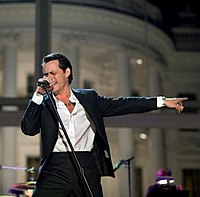
Latin artist Marc Anthony'south self-titled English-language anthology released in 1999 had singles that crossed over to the AC charts.[thirty]
The early 1990s marked the softening of urban R&B in the shape of new jack swing, at the same time alternative rock emerged and traditional pop saw a meaning resurgence. This in part led to a widening of the market place, not only allowing to cater to more niche markets, just information technology also became customary for artists to make Ac-friendly singles. At the same time, the genre began adopting elements from difficult rock as tastes were shifting towards louder music, while AC stations in general began playing more than rock acts. "Softer" features such equally light instrumental music (carried over from the beautiful music format—many Ac stations carried the format until the early 1970s), new age songs and most pre-1964 artists were gradually phased out from Air-conditioning radio throughout the early-mid 1990s.
Unlike the majority of 1980s mainstream singers, the 1990s mainstream pop/R&B singers such every bit All-4-One,[31] Boyz II Men, Christina Aguilera,[32] Backstreet Boys and Fell Garden[32] by and large crossed over to the AC charts. Latin pop artists such as Lynda Thomas,[33] Ricky Martin, Marc Anthony, Selena, Enrique Iglesias and Luis Miguel also enjoyed success in the Air conditioning charts.
In addition to Celine Dion, who has had significant success on this nautical chart, other artists with multiple number ones on the Air-conditioning chart in the 1990s include Mariah Carey, Phil Collins, Michael Bolton, Bryan Adams, Whitney Houston and Shania Twain. Newer female person Adult album alternative vocalizer-songwriters such as Sarah McLachlan, Natalie Merchant, Gem, Melissa Etheridge and Sheryl Crow likewise broke through on the Air-conditioning chart during this time.[34]
In 1996, Billboard created a new chart chosen Developed Top xl, which reflects programming on radio stations that exists somewhere betwixt "adult contemporary" music and "popular" music. Although they are sometimes mistaken for each other, the Adult Contemporary chart and the Developed Top 40 chart are separate charts, and songs reaching 1 chart might not reach the other. In addition, hot Ac is some other subgenre of radio programming that is distinct from the Hot Developed Gimmicky Tracks nautical chart as it exists today, despite the apparent similarity in name.
In response to the pressure on Hot AC, a new kind of Ac format cropped up among American radio recently. The urban adult contemporary format (a term coined by Barry Mayo) usually attracts a big number of African Americans and sometimes Caucasian listeners through playing a peachy bargain of R&B (without whatsoever course of rapping), gospel music, classic soul and trip the light fantastic toe music (including disco).
Another format, rhythmic AC, in addition to playing all the pop hot and soft Air-conditioning music, past and present, places a heavy emphasis on disco every bit well as 1980s and 1990s trip the light fantastic hits, such equally those by Amber, and Black Box, and includes dance remixes of pop songs, such as the Soul Solution mix of Toni Braxton's "Unbreak My Centre".
In its early years of existence, the polish jazz format was considered to be a course of AC, although it was mainly instrumental, and related a stronger resemblance to the soft AC-styled music. For many years, George Benson, Kenny G and Dave Koz had all had crossover hits that were played on both smoothen jazz and soft AC stations.
2000s–present: AC music goes mainstream and mainstream music goes Air-conditioning [edit]

A number of Michael Bublé's singles and albums topped the AC charts in the 2000s and 2010s.[35]
During the 2000s, the AC market place gained an increased presence in the music industry, equally its radio formats were pop nationwide—Smooth jazz and "Urban AC" stations were ubiquitous in the East Coast, while Soft rock and "adult standards" stations were mutual in the Midwest, and pop-oriented "Hot Air conditioning" and "world music"/Hispanic AC stations were easily found in the West Coast and the "Sun Chugalug". This led to the presence of numerous genres on the Air-conditioning charts, often crossing to the "popular" charts, winning over many critics in the need to define AC, and increased the tolerance and acceptance of Air conditioning music into mainstream day-to-mean solar day radio play.
Josh Groban's single "Y'all Raise Me Up" and Michael Bublé'due south cover of "Fever" are often cited as fundamental examples of the high production values and carol-heavy sound that defined 2000s-era Air-conditioning,[12] often dubbed as "jazz-pop", heavily conveying classical, jazz and traditional pop influences. Artists such equally Nick Lachey, James Edgeless, Jamie Cullum, John Mayer, Jason Mraz, Norah Jones, Diana Krall, Amy Winehouse and Susan Boyle also accomplished not bad success during this period. During most of the 2000s, land music/countrypolitan musicians such as Kelly Clarkson, Clay Aiken, Billy Joel, Garth Brooks, Shania Twain, LeAnn Rimes and Carrie Underwood scored hits on soft AC, especially in Southern states. A pop trend in the belatedly 1990s and 2000s was remixing trip the light fantastic music hits into adult contemporary ballads, especially in the US, (for example, the "Candlelight Mix" versions of "Heaven" by DJ Sammy, "Listen To Your Heart" by D.H.T., and "Everytime We Touch" past Cascada).
Fundamental to the success of AC in the 2000s was the 25–34 demographic which had outgrown the pop music offerings of the time, most new rock became also alternative and harsh for AC radio and most new pop was now influenced heavily by dance-popular, hip-hop and electronic trip the light fantastic toe music.[36] At the aforementioned time, the music manufacture too began to focus on older audiences and markets generally considered "niche".
During the late 2000s, certain pop songs began inbound the AC charts instead, by and large after having recently fallen off the Hot 100. Adrian Moreira, senior vice president for developed music for RCA Music Grouping, said, "Nosotros've seen a adequately tidal shift in what AC volition play". Rather than emphasizing older songs, adult contemporary now began playing many of the same songs as meridian twoscore and adult elevation 40, but only after the hits had become established.[12] An article on MTV'due south website by Corey Moss describes this tendency as: "In other words, Air conditioning stations are where pop songs go to die a very long death. Or, to optimists, to get a second life."[37] As adult contemporary has long characterized itself equally family-friendly, "make clean" versions of popular songs began appearing on the AC chart, equally were the cases of "Perfect" by P!nk, and "Forget You" by Cee Lo Green, both in 2011.[12]
AC radio'due south shift into more mainstream pop was a result of the changes on the dissemination landscape post-obit the 2005–2007 economic downturn and eventual recession, every bit advertisers preferred more profitable chart-based formats, which meant the demise of many AC-based formulas, primarily those aimed at older audiences, with tastes changing towards more modern music amongst all historic period groups. Diminishing physical tape sales throughout the 2010s also proved a major accident to the AC genre, and there are concerns that the portable people meter, a device being used to determine radio listenership, may be incompatible with AC songs and may not accurately pick up that a person is listening to an AC station because of the pitches and frequencies used in the style.[38]
Central AC artists of the early-mid 2010s included Bruno Mars, Coldplay, Adele, Arcade Fire, Meghan Trainor, Maroon 5 and Ed Sheeran, featuring a more pop-influenced, uptempo way than the typical Ac fare of previous years, as well featuring production values reminiscent of the Motown audio and the so-called Wall of Sound that dominated the soul-heavy pop charts of the early 1960s, when the Like shooting fish in a barrel Listening chart was kickoff introduced. The before years of the decade also saw alternative and indie stone acts such as Wilco, Feist, The 1975, Imagine Dragons, Mumford & Sons, Of Monsters and Men and The Lumineers quickly becoming AC mainstays,[39] [40] although these were eventually replaced past rhythm-based rock bands such as Panic at the Disco, Neon Trees X Ambassadors, Sheppard, Bastille, American Authors, Fitz and the Tantrums, Foster the People, 20 One Pilots, Walk the Moon and Milky Chance.
During the middle of the decade, newer artists such as CeeLo Green, One Republic, Rachel Platten, Christina Perri, Andy Grammer, James Bay, Sara Bareilles, Shawn Mendes, Sia, Sam Smith, Gavin Degraw, Charlie Puth and Colbie Caillat as well every bit acts that were pop in the 1990s and early 2000s such equally Britney Spears and Christina Aguilera were added to the rotation of about Air-conditioning stations.
Equally trap music and similar styles of hip-hop began dominating superlative forty stations during the last years of the 2010s, AC stations began picking upwardly rhythmic artists like Rihanna, Lady Gaga, Ellie Goulding, Taio Cruz and Pitbull as well as EDM artists like Avicii, Daft Punk, Calvin Harris, David Guetta and Tiesto. Meanwhile, younger artists like Camila Cabello, Justin Bieber, Selena Gomez, Ariana Grande, Nick Jonas and the Jonas Brothers and Halsey began to be featured on AC stations more than on top 40 stations.[ citation needed ]
Adult contemporary formats [edit]
In radio broadcasting, developed contemporary is divided into several sub-formats, each with their ain musical management and demographic targeting. Hot adult contemporary formats mostly feature an uptempo rotation of recent hits that appeal to a broad adult audience.[41] A station formatted as "adult contemporary" with no qualifier, likewise referred to as "mainstream developed contemporary", by and large has a similar playlist to hot Ac stations, but with a broader rotation of classic hits from by decades.[42] [41]
Soft adult contemporary formats have a more conservative sound oriented primarily towards adult women, urban AC focuses on R&B and soul music that appeal to African American adults, and rhythmic AC focuses on dance music and other rhythmic genres.
Hot adult contemporary [edit]
Hot developed contemporary (hot Air conditioning) radio stations play a wide range of popular music that appeals towards the 18–54 age group,[43] it serves every bit a center footing betwixt the youth-oriented contemporary striking radio (CHR) format, and adult gimmicky formats (such every bit "mainstream" and soft AC) that are typically targeted towards a more mature demographic. They generally feature uptempo hit music with broad appeal, such equally pop and pop rock songs, while excluding more youth-oriented music such equally hip-hop.[42] [41] Recurrents usually reflect familiar and youthful music that adults had grown upwards with.[44] [41] Similarly, matured pop acts such as the Backstreet Boys, Jason Mraz, John Mayer, and Pinkish have been fixtures of present-day hot Ac stations, while alternative and indie rock crossovers (such as Foster the People, Imagine Dragons, Lovelytheband, Portugal. The Man, and Xx One Pilots) became more prevalent within the format during the 2010s.[41] [40] Many hot Ac outlets are among the pinnacle stations in their corresponding marketplace.[41]
The "hot AC" designation began to announced in the 1990s, to describe developed contemporary stations with a more than energetic presentation and uptempo sound than their softer counterparts.[45] An early example of the format, Houston'south KHMX Mix 96.5, climbed from 14th place in the market place to third in the half dozen months after its launch. The station'south format and branding was widely replicated by other stations.[46]
Initially focused more on pop stone, the format has evolved to reflect changes in the composition of this audience; by the mid-2000s, the format had evolved to include more uptempo pop music,[44] [41] helping to expand their audition amid younger listeners such every bit millennials; Nielsen Sound ranked hot Ac as the third most-popular format among millennials, backside popular and country music.[41] [42] Of the format'south expanding demographic accomplish, WOMX-FM programme director Dana Taylor stated that hot AC stations "may not exist the radio station that everybody agrees on, but it'south a radio station that everybody goes, 'I'm okay with that'."[41] The increasingly downtempo management of popular hits in the mid-to-late 2010'south also helped to concenter boosted listeners.[42]
Hot AC stations typically keep a larger trunk of recent hits in rotation than those with rigid, chart-driven formats similar CHR and urban gimmicky. As these stations' playlists have go concentrated towards airing only the electric current hits at a given time, hot AC airplay tin build and sustain a song's popularity over a long-term menstruation. This effect has been credited in helping build an audition for early on singles from new acts such as Adele, Rachel Platten ("Fight Song", which achieved mainstream popularity afterward its use during Hillary Clinton'south 2016 presidential election campaign), and Max Schneider (whose 2016 single "Lights Down Low", over a year after its original release, became a sleeper hit on the Billboard Mainstream Summit twoscore and Hot 100 due in function to strong hot AC airplay).[41] [47] [48]
The popularity of the hot Ac format prompted many mainstream Air conditioning stations to add uptempo music to their playlists, while still maintaining a deeper rotation of older hits than hot AC stations.[42] [41]
Modern developed contemporary [edit]
Modernistic adult contemporary refers to AC formats with a stronger lean towards modern rock and pop stone.
In the 1990s and early on 2000s, modern Air conditioning was typically targeted towards women, with Mike Marino of KMXB in Las Vegas describing the format as reaching "an audition that has outgrown the edgier hip-hop or alternative music only hasn't gotten old and sappy enough for the soft ACs."[49] The format typically focused on female rock acts such as Shawn Colvin, Sheryl Crow, Indigo Girls, Jewel, and Sarah McLachlan, and folk rock-influenced bands such as Counting Crows and The Wallflowers.[fifty] [51] [52]
Soft adult contemporary [edit]
The Soft developed contemporary format typically targets women 25–54 and at-work listening. Soft Air conditioning playlists are by and large conservative in comparison to hot AC, focusing on pop and power ballads, soft rock, and other familiar, light hits.[53] Upon its establishment in the 1980s, the soft AC format was positioned equally beingness a more than upbeat version of piece of cake listening that would entreatment better to a younger audience, mainly by excluding instrumental beautiful music. Easy listening stations had begun shifting to the format out of business organisation that their existing programming would not appeal to the electric current generation of listeners.[45]
In a 1990 article, James Warren of the Chicago Tribune characterized soft AC stations as being "as heart-of-the-road and unthreatening as mod media get", with personalities that were encouraged to be as inoffensive and "depression-profile" as possible, and a more than conservative music library than hot AC-leaning stations. In detail, Chicago's WLIT did not accept its airstaff talk over the offset and endings of songs (in contrast to the hot AC-leaning WFYR), and played Bob Seger's "We've Got Tonite" only not "Old Fourth dimension Stone and Curlicue" (which was part of WTMX's playlist). The director of a soft AC station in Connecticut, WEZN-FM, told Warren that he had barred the reading of elevation-of-hour news headlines, so that listeners wouldn't exist tempted to tune abroad to an all-news station to acquire more.[45]
Soft AC stations tend to exist more selective in their music libraries than other developed contemporary stations, preferring proven songs over electric current hits.[45] Upon the onset of the format's popularity, core artists typically included singers such as Nat King Cole, Perry Como, Neil Diamond, Barry Manilow, Johnny Mathis, and Barbra Streisand. Past the 1990s, to improve their entreatment amongst irresolute demographics, some soft AC stations began to widen their playlist to include selections from contemporary acts such every bit Bon Jovi, Bryan Adams, Celine Dion, Mariah Carey, Eric Clapton, Phil Collins, Elton John, and Whitney Houston. On the other paw, by 1996, New York's WLTW had begun to stage out its softer music in favor of a more uptempo direction.[45] [54] [55] [56]
In 2017, Inside Radio reported that soft Air conditioning had the third-largest subtract in U.Southward. stations offering the format over the past decade (at 128), ranking behind only adult standards and oldies—a shift credited to crumbling demographics and a major boom in the wider-highly-seasoned classic hits format (which saw the largest overall increase over the aforementioned flow). Consultant Gary Berkowitz argued that the soft AC format had go increasingly irrelevant in comparison to mainstream and hot Ac, due to PPM markets preferring uptempo music.[57]
At the same fourth dimension, however, soft AC began to experience a resurgence. In Apr 2016, iHeartMedia flipped its San Francisco classic soul station KISQ to soft AC as The Breeze; as of November 2018, it was the top station in the Bay Expanse. The trend continued into 2017 and 2018, with iHeartMedia extending its Breeze brand to other soft Air-conditioning flips, and the brand (amid others) being adopted by competitors such as Entercom.[21] [53] Industry analyst Sean Ross argued that older demographics were becoming more lucrative due to changes in listening habits among younger audiences, which prefer digital platforms such as music streaming services over linear terrestrial radio, and also noted how mainstream AC was dependent on the Peak forty charts to break new songs.[53]
Current soft AC stations have continued to feature recurrents such as Michael Bolton, Celine Dion, Elton John, Fleetwood Mac, Hall & Oates, and Whitney Houston, while contemporary musicians such as Adele and Michael Bublé have likewise become mod fixtures of the format.[58] [59] [53] [57] In addition, the soft Ac audio has diversified to include more songs that are "safe and universal" and not necessarily "soft", with Ross presenting examples such as Simple Minds' "Don't You (Forget Nigh Me)", equally well as the retroactively-divers genre of yacht rock.[53] Over time, some stations have gradually adjusted their playlists to include more recurrents from the 1980s and 1970s (although non to the same extent as other "soft oldies" formats, such as MeTV FM, which have besides grown in popularity).[sixty]
Urban adult contemporary [edit]
The Urban adult contemporary format focuses primarily on current and classic R&B and soul music. The format typically targets African-American adults: July 2018 numbers from Nielsen Audio recorded information technology as the pinnacle format amid African-Americans 25–54 and 35–64.[61] It also has a sizable popularity amid younger listeners, ranking behind urban contemporary as the second-about popular format among African-American adults 18–34 in the same written report, with an 18.nine audition share.[61]
The format typically excludes youthful rhythmic music, such as commercial hip-hop and rap, that are commonly associated with the urban contemporary format.[62] [63] [64] The urban Ac format is too associated with the "repose tempest"—programming (such as the syndicated Keith Sweat Hotel) focusing on mellower R&B ballads and wearisome jams, often in a jazz-influenced fashion.[65] [66] [67] [68]
As urban contemporary stations prefer hit-driven hip-hop songs, labels typically service R&B songs to the urban AC format only. Some current R&B musicians have complained that this is an artificial divide that prevents them from reaching a wider, mainstream audition (citing the relatively smaller number of urban AC outlets in comparison to urban and rhythmic), even with attempts to give some singles a hip-hop-influenced sound to amend the potential for crossover appeal. Some acts accept attempted to disassociate themselves from "R&B" to reduce the effect of this stigma, although streaming services have helped to expose R&B to a wider audition across urban Air conditioning radio.[69] [70]
Rhythmic developed contemporary [edit]
The Rhythmic adult contemporary format generally focuses on a variety of electric current and classic trip the light fantastic toe music, such as trip the light fantastic-popular, hip-hop, and R&B (often resembling a blend of the Classic hits and hot Air-conditioning formats in exercise). The exact composition of current and recurrent content tin vary between stations, depending on regional preferences and the heritage of rhythmic formats in the market, ranging from late-80s/early on-90s dance hits (including freestyle), to disco and Motown. Rhythmic Hot Ac has also been used equally a format, popularized by stations such as New York'south WKTU.[71] [72] [73] [74] [75]
Polish adult contemporary [edit]
Smooth Developed Contemporary was evolved from smooth jazz stations, to attract more younger listeners (specially in the important 25–54 age demographic) without completely alienating jazz fans. Smooth Air-conditioning stations played more than of the vocalists popular on polish jazz stations, such as Luther Vandross, Sade, Anita Baker, and Basia, Diana Krall,[76] while incorporating more mainstream and urban AC material from artists such as Celine Dion, Mary J. Blige and limiting instrumentals to 2 or three cuts an hour (and usually restricting airplay of instrumentals to artists such as Kenny One thousand and Chuck Mangione who had crossover pop success). In markets where they existed, Shine AC stations were meant to fill a void for soft music created past the mainstream Adult Gimmicky format's overall move toward more uptempo adult Meridian-xl musical fare.
Contemporary Christian music [edit]
Gimmicky Christian music (CCM) has several subgenres, ane being "Christian AC". Radio & Records, for instance, lists Christian AC amidst its format charts. There has been crossover to mainstream and hot AC formats past many of the cadre artists of the Christian Air conditioning genre, notably Amy Grant, Michael W. Smith, Kathy Troccoli, Steven Curtis Chapman, Plumb, and more recently Big Daddy Weave, Casting Crowns, For King & Country, Lauren Daigle, MercyMe, and Newsboys.
Christmas music [edit]
Since the 1990s it has go common for many AC stations, peculiarly soft Ac stations, to play primarily or exclusively Christmas music during the Christmas flavour in November and December. While these tend mostly to be contemporary seasonal recordings by the same few artists featured nether the normal format, almost stations volition as well air some vintage holiday tunes from older pop, MOR, and adult standards artists – such as Mannheim Steamroller, Trans-Siberian Orchestra, Nat King Cole, Bing Crosby, Dean Martin, The Carpenters, Percy Faith, Johnny Mathis and Andy Williams – many of whom would never be played on these stations during the rest of the twelvemonth.
These Christmas music marathons typically start a few weeks before Thanksgiving 24-hour interval and stop after Christmas Day, or sometimes extending to New year. Afterward, the stations commonly resume their normal music fare. Several stations begin the vacation format much before, at the beginning of Nov especially after Halloween. The roots of this tradition tin can be traced back to the beautiful music and easy listening stations of the 1960s and 1970s.[ commendation needed ]
Syndicated radio shows and networks carrying the adult contemporary format [edit]
- Delilah – I of the USA'due south most popular radio shows, Delilah airs primarily in the evening. Its Christmas Edition airs from mid-November to tardily December.
- Intelligence for Your Life – Hosted by John Tesh, this bear witness as well airs evenings and also on weekends.
- American Top twoscore with Ryan Seacrest – One version of AT40 airs on USA hot AC stations, which is a little unlike from its Top-40/CHR counterpart.
- Rick Dees Weekly Top 40/Weekly Top 30 – Began offering Hot Air conditioning versions of the popular countdown show in June 1996. These shows feature the superlative 20 Hot Ac songs in the USA along with well-nigh 10 past hits from the 1980s, 1990s and early 2000s (decade). A softer "Ac" version was added in July 2009 to try to fill in the void left by Casey Kasem ending his Air-conditioning countdown.
- Radio Disney Music Peak xxx Countdown, One version is for Hot AC stations, the other version is for Mainstream AC stations. Plays the USA Summit 30 songs of the week co-ordinate to Mediabase and a music rating service called ratethemusic.com. This evidence, like Rick Dees' show, is distributed by Compass Media Networks.
- Backtrax USA with Kid Kelly – Weekend programs focusing on the '80s and '90s, targeted for hot AC stations.
- ABC and Punch Global both offer AC 24-hour networks programming soft and hot Ac.
- Tom Joyner and Steve Harvey accept popular morning shows that air on urban AC (and sometimes Hip-Hop) stations. Both shows are often heard on competing stations in the same city, such every bit St. Louis, Philadelphia and Atlanta. Joyner'due south show is syndicated by ABC Radio, and Harvey's show past Premiere Radio Networks.
- Retro Rewind with Dave Harris is weekend based radio show highlighting a massive playlist of songs from the '80s and '90s, interviews, spotlights and contests. The show is washed LIVE across the USA on Sabbatum nights, taking audition requests. The show is targeted towards HOT Air-conditioning and AC radio stations.
- The EZ Rock network is a brand/network of soft AC heard in Canada.
- Heart FM Network A radio network in the UK that grew throughout 2009 as more stations were rebranded as "Center".
- Smooth Radio – A United kingdom of great britain and northern ireland-wide radio network that formed from six regional Shine Radio stations.
- Smoothfm – A network of two Australian commercial radio stations (based in Sydney and Melbourne) that are focused on providing an eclectic like shooting fish in a barrel-listening playlist, usually featuring ballads.
- Nova – A network of five Australian commercial radio station (based in Sydney, Melbourne, Brisbane, Adelaide and Perth) that are very similar to Smoothfm.
- The Breeze – A group of New Zealand adult contemporary radio stations owned by MediaWorks Radio. There are 20 stations currently dissemination throughout New Zealand.
- The Bob and Sheri Evidence – American morning time bulldoze show based in Charlotte, North Carolina. Heard on more than l AC stations and the American Forces Network
Former syndicated programming includes Dick Clark'southward US Music Survey (1996–2005), Casey's Hot 20/Casey's Countdown/American Top twenty/10 (1992–2009) and Top 30 USA.
Encounter also [edit]
- Developed Gimmicky, a chart appearing in Billboard since 1961. This nautical chart is typically (but not exclusively) closer to soft Ac.
- New-age music
- Yacht rock
References [edit]
- ^ Billboard Staff (May 1, 2017). "Being Celine: A Look Dorsum at the Illustrious Career of Celine Dion". Billboard. Archived from the original on May v, 2017. Retrieved Nov 26, 2018.
- ^ "Oldies Music Glossary: "Adult Contemporary"". Archived from the original on February 2, 2012. Retrieved Baronial 4, 2008.
- ^ "Soft Rock Music – What is Soft Rock? – Oldies Music Songs and Artists". Oldies.about.com. September vi, 2012. Archived from the original on January 21, 2012. Retrieved October 3, 2012.
- ^ "Adult Contemporary : Significant Albums, Artists and Songs, Most Viewed". AllMusic. Archived from the original on May 31, 2012. Retrieved Oct three, 2012.
- ^ Starr, Larry (2007). "Chapter xi: Key Terms and Definitions". American popular music : from minstrelsy to MP3. New York: Oxford University Press. ISBN978-0-19-530053-6. OCLC 70259055. Archived from the original on January 2, 2011.
- ^ a b Browne, R. B.; Browne, P., eds. (2001). The Guide to United States Popular Culture. Popular Printing. p. 687. ISBN0-87972-821-iii.
- ^ "Pop Music – What Is Popular Music – A Definition and Brief History". Top40.nearly.com. September 7, 2012. Archived from the original on Oct 20, 2005. Retrieved October iii, 2012.
- ^ a b Curtis, J. M. (1987). Rock eras: interpretations of music and club, 1954–1984. Pop Press. p. 236.
- ^ "Adult Gimmicky's Demographic Fault Line Is Now 45". All Admission. August three, 2012.
- ^ Brecht, Robert M. (May 31, 2011). "Advertising Shifting to Targeting Older Demographic Segments". DMN3 Blog. DMN3. Archived from the original on April seven, 2014. Retrieved March 17, 2012.
- ^ Bush-league, John (September 30, 1935). "Johnny Mathis – Music Biography, Credits and Discography". AllMusic. Archived from the original on March 14, 2021. Retrieved October 3, 2012.
- ^ a b c d e f m Trust, Gary (July 23, 2011). "Vanilla Is Licking the Competition". Billboard. Vol. 123, no. 25.
- ^ Goldsmith, Melissa Ursula Dawn (February 23, 2005). "Project MUSE – Lounge Caravan: A Selective Discography". Notes. 61 (four): 1060–1083. doi:x.1353/not.2005.0059. S2CID 191619811.
- ^ Huey, Steve (June 17, 1943). "Barry Manilow – Music Biography, Credits and Discography". AllMusic. Archived from the original on March 14, 2021. Retrieved October 3, 2012.
- ^ "1960s Music History including Sixties Styles, Bands and Artists". Archived from the original on July 29, 2019. Retrieved July 16, 2019.
- ^ Keith, M. C. (2009). The Radio Station: Broadcast, Satellite and Internet (8th ed.). Focal Printing. p. 14. ISBN978-0-240-81186-four.
- ^ "Soft Rock : Significant Albums, Artists and Songs, Virtually Viewed". AllMusic. Archived from the original on February 27, 2021. Retrieved January 9, 2013.
- ^ "Soft Rock – Profile of the Mellow, Romantic Soft Rock of the '70s and Early '80s". 80music.about.com. April 12, 2012. Archived from the original on January 16, 2013. Retrieved January 9, 2013.
- ^ Buckley, P. (2003). The Rough Guide to Stone (tertiary ed.). Rough Guides. p. 378.
- ^ Sterling, C. H.; Keith, M. C. (2008). Sounds of Alter: a History of FM broadcasting in America. UNC Press. pp. 136–7.
- ^ a b Jacobson, Adam (December 27, 2018). "A Welcome 'Breeze,' Or A Stiff Current of air For Radio?". Radio & Television Business organisation Written report. Archived from the original on January 8, 2019. Retrieved Jan eight, 2019.
- ^ "Careless Whisper – Wham!". Billboard . Retrieved October 3, 2012.
- ^ Deming, Mark (June 25, 1963). "George Michael – Music Biography, Credits and Discography". AllMusic. Archived from the original on September 2, 2009. Retrieved Oct 3, 2012.
- ^ "Journey: The ring who did not finish believing". BBC News. November 12, 2010. Archived from the original on November xvi, 2010. Retrieved December 6, 2010.
- ^ "10 Best Soft Rock Ballads". Made Human being. Nov 2, 2010. Archived from the original on November xiii, 2010. Retrieved December half-dozen, 2010. "Journey fans can easily list a dozen soft rock ballads from the band..."
- ^ Ruhlmann, William. "Phil Collins Biography". AllMusic. Archived from the original on October ane, 2013. Retrieved April 21, 2014.
- ^ Ruhlmann, William. "Amy Grant – Music Biography, Credits and Discography". AllMusic. Archived from the original on Jan 25, 2021. Retrieved October 3, 2012.
- ^ Prato, Greg (January 21, 1950). "Billy Body of water – Music Biography, Credits and Discography". AllMusic. Archived from the original on March 14, 2021. Retrieved October 3, 2012.
- ^ Fawthrop, Peter (May 24, 1970). "Tommy Page – Music Biography, Credits and Discography". AllMusic. Archived from the original on September twenty, 2020. Retrieved October three, 2012.
- ^ Harris, Craig. "Marc Anthony – Music Biography, Credits and Discography". AllMusic. Archived from the original on February 11, 2021. Retrieved October three, 2012.
- ^ "All-four-Ane Anthology & Song Chart History". Billboard . Retrieved October iii, 2012.
- ^ a b "Mariah Carey Music News & Info". Billboard . Retrieved October three, 2012.
- ^ "Lynda realiza su internacionalización" (in Spanish). terra.com.mx. Archived from the original on Oct 23, 2013. Retrieved March 27, 2015.
- ^ Hyatt, Wesley (1999). The Billboard Book of Number One Adult Gimmicky Hits. New York Urban center: Billboard Books. ISBN978-0-8230-7693-ii.
- ^ Latham, Aaron (September 9, 1975). "Michael Bublé – Music Biography, Credits and Discography". AllMusic. Archived from the original on February 24, 2021. Retrieved October three, 2012.
- ^ Whitburn, Joel (2007). Billboard Peak Adult Songs 1961–2006. Record Research Inc. p. 373.
- ^ "Never A 'Bad Twenty-four hour period' — Developed-Contemporary Radio, Where Pop Hits Live Potent". MTV News. Oct 31, 2006.
- ^ Boudway, Ira (June fourteen, 2016). "The Queen of FM Fights for Her Throne". Bloomberg Business Week. Archived from the original on June 23, 2017. Retrieved June 15, 2016.
It's destroying radio in general, and specially shows that don't play for the meter.
- ^ "MediaBase – Log in". world wide web.americasmusiccharts.com. Archived from the original on Baronial 23, 2015. Retrieved September ten, 2016.
- ^ a b Kelley, Frannie (October 26, 2011). "Has 'Indie' Become 'Adult Contemporary'? : The Record". NPR. Archived from the original on May 4, 2012. Retrieved October 3, 2012.
- ^ a b c d e f 1000 h i j yard Leight, Elias (October 20, 2018). "Developed Radio Was Once the Butt of Jokes. Now It'south the Hottest Radio Format". Rolling Stone. Archived from the original on November 12, 2018. Retrieved Nov 12, 2018.
- ^ a b c d eastward "With CHR Polarizing, Are AC & Hot Air conditioning The New Top 40?". Insideradio.com. Archived from the original on May 13, 2021. Retrieved November 13, 2018.
- ^ Schiffman, Marc; Hall, Dana (June 14, 1997). "Modern debates value of '80s gilded". Billboard. Vol. 109, no. 24. p. 75.
- ^ a b Zapoleon, Guy. "Hot Ac – Where Does It Stand?". All Access. Archived from the original on Nov nineteen, 2018. Retrieved November xix, 2018.
- ^ a b c d eastward Warren, James. "When 'Easy' radio goes 'Soft,', things can get difficult". Chicago Tribune. Archived from the original on Nov xix, 2018. Retrieved November nineteen, 2018.
- ^ Mariani, Anthony (November xviii, 1999). "Mix Master". Houston Printing. Archived from the original on Nov twenty, 2018. Retrieved November xix, 2018.
- ^ "MAX's 'Lights Downwardly Low,' Featuring gnash, Shines at No. 1 on Developed Popular Songs Chart". Billboard. Archived from the original on June 13, 2018. Retrieved November 12, 2018.
- ^ "Hot 100 Nautical chart Moves: MAX Hits the Height 40 With 'Lights Down Low'". Billboard. Archived from the original on June thirty, 2018. Retrieved November 12, 2018.
- ^ Burns, Alan (December 13, 1996). "Modern Air conditioning & The 25-44 Revolution" (PDF). R&R: 12.
- ^ "Getting To Know She Radio Will Accept Time". Orlando Watch. Archived from the original on December 23, 2018. Retrieved December 22, 2018.
- ^ FARLEY, CHRISTOPHER JOHN (June 24, 2001). "GALAPALOOZA!". Time. ISSN 0040-781X. Archived from the original on November 3, 2019. Retrieved December 22, 2018.
- ^ Writer, JERI ROWE Staff. "Land, RAP MUSIC Lead RADIO PACK". Greensboro News and Record. Archived from the original on May 17, 2021. Retrieved December 22, 2018.
- ^ a b c d e Ross, Sean (November fifteen, 2018). "Why Soft Air conditioning Is Booming Now". RadioInsight. Archived from the original on November 16, 2018. Retrieved Nov xix, 2018.
- ^ Elliott, Stuart. "THE MEDIA BUSINESS: ADVERTISING; WLTW-FM finds success with an ever-evolving definition of 'soft' developed gimmicky music". Archived from the original on November 19, 2018. Retrieved Nov nineteen, 2018.
- ^ Part Radio: No Longer Monolithic. Billboard. Nielsen Business Media. November 23, 1996. Archived from the original on May 17, 2021. Retrieved October 24, 2020.
- ^ AC Dominates Arbitrons. Billboard. Nielsen Business Media. January eighteen, 1986. Archived from the original on May 17, 2021. Retrieved Oct 24, 2020.
- ^ a b "Here Are The Biggest Format Gainers And Losers Of By Decade". Insideradio.com. Archived from the original on May 17, 2021. Retrieved November 19, 2018.
- ^ "Westwood Ane To Launch Soft Ac Network". RadioInsight. June 16, 2016. Archived from the original on November 19, 2018. Retrieved November xix, 2018.
- ^ "All-time Kept Hugger-mugger? Stations Appealing To Boomers Flourish". Insideradio.com . Retrieved Nov xix, 2018.
- ^ "Fresh Listen: KISQ (The Breeze) & WFEZ (Like shooting fish in a barrel 93.1)". RadioInsight. Nov 8, 2019. Archived from the original on November 5, 2019. Retrieved November eight, 2019.
- ^ a b "Urban Ac Expands Its Ascendant Share Of Black Listeners". Insideradio.com. Archived from the original on April 20, 2019. Retrieved April xx, 2019.
- ^ Leight, Elias (March 21, 2019). "In a 'Restrictive' Globe, Leela James Sings Whatever She Wants". Rolling Stone. Archived from the original on March 22, 2019. Retrieved April 20, 2019.
- ^ Stroud, Court. "Everything You Demand To Know About Urban Radio". Forbes. Archived from the original on April 20, 2019. Retrieved Apr xx, 2019.
- ^ Foley, Aaron (October 24, 2011). "The death of 107.five, or why urban radio in Detroit continues on its downward spiral". mlive.com. Archived from the original on Apr 20, 2019. Retrieved April xx, 2019.
- ^ Beamon, Todd (Feb 19, 1987). "Durable Radio Format Survives Shift in Tastes". The New York Times. ISSN 0362-4331. Archived from the original on April xx, 2019. Retrieved April twenty, 2019.
- ^ "Clear Channel Chicago intros new evening programs on two urban outlets". Chicago Business Journal. Archived from the original on May 17, 2021. Retrieved Apr 20, 2019.
- ^ Coscarelli, Joe (September 6, 2018). "A Champion, a Critic, a Therapist: Dyana Williams Is Hip-Hop's Artist Whisperer". The New York Times. ISSN 0362-4331. Archived from the original on Apr 20, 2019. Retrieved April 20, 2019.
- ^ Caramanica, Jon (August 7, 2009). "K'Jon, Maxwell and More Offer a Newly Mature Soul Music". The New York Times. ISSN 0362-4331. Archived from the original on April 20, 2019. Retrieved April xx, 2019.
- ^ Leight, Elias (October 13, 2017). "How Hip-Hop Edged Grittier R&B Singers Out of the Mainstream". Rolling Stone. Archived from the original on April 20, 2019. Retrieved April 20, 2019.
- ^ Leight, Elias (October 13, 2018). "The Render of Quiet Storm". Rolling Stone. Archived from the original on April 20, 2019. Retrieved Apr xx, 2019.
- ^ Buhler, Brendan (September 12, 2006). "Tin can't find your doo-wop, try Whoopi in mornings". Las Vegas Dominicus. Archived from the original on Nov 27, 2019. Retrieved April 29, 2019.
- ^ French, Alex (July 17, 2015). "How Hip-Hop Is Becoming the Oldies". The New York Times. ISSN 0362-4331. Archived from the original on May thirteen, 2019. Retrieved April 29, 2019.
- ^ "Intriguing Stations of 2018". RadioInsight. February 28, 2019. Archived from the original on June three, 2019. Retrieved Apr 29, 2019.
- ^ "I101 Chicago Shifts To Rhythmic Hot AC". RadioInsight. December nine, 2013. Archived from the original on April 28, 2019. Retrieved Apr 29, 2019.
- ^ Ross, Sean (August 24, 2006). "Rhythmic Ac: In Search Of The Funky Common cold Medina". Edison Enquiry. Archived from the original on November 27, 2019. Retrieved April 29, 2019.
- ^ "CALM RADIO - Jazz Vocalists - Jazz". radio.net. Archived from the original on March 27, 2019.
{{cite spider web}}: CS1 maint: unfit URL (link)
External links [edit]
- Artists | Ambition Entertainment
- Rebirth Music Productions
- GAD Music Visitor
DOWNLOAD HERE
Posted by: barrettards1981.blogspot.com

Post a Comment for "Casey Kasem At40 The 70s Free Download UPDATED"